Showing posts with label tour. Show all posts

Friday, November 4, 2011

East Mebon, Siem Reab

    East Mebon How to go: Location: Description: Also built in the 10th Century by Rajendravarman, this temple was situated on a small island in the middle of the Oriental, or Eastern, Baray. It has all the characteristics of the mountain temple but was accessible by boat only. From the inscriptions found close to it, we know that Rajendravarman dedicated it to his parents.

East Mebon is a large temple-mountain-like ruin, rising three levels and crowned by five towers. Jayavarman IV, a usurper to the throne, moved the capital from Angkor to Koh Ker in 928AD. Sixteen years later Rajendravarman II returned the capital to Angkor and shortly thereafter constructed East Mebon on an island in the middle of the now dry Eastern Baray. The temple is dedicated to Shiva in honor of the king?s parents. Inscriptions indicate that it was also built to help reestablish the continuity of kingship at Angkor in light of the interruption that occurred when the seat of power had been moved to Koh Ker. There seems to be some scholarly debate as to whether East Mebon should be categorized as a temple-mountain. Inscriptions record activity at the temple as early as 947AD, but East Mebon was not consecrated until 952AD.

You need to use quite a bit of imagination when visiting the East Mebon temple. It's not that the temple is badly ruined. The imagination is needed to think of the temple as it originally existed, as an island in the middle of a large artificial lake, the Eastern Baray.

When it was built, around 952, the East Mebon must have been quite impressive. The pyramidal structure consists of three concentric tiers crowned by five towers. It is a typical motif of many Angkor temples, which seek to represent Mount Meru, the location of the Hindu "heaven". It must have been highly symbolic, rowing a boat across the lake to one of the temple's four landings, then climbing up the tiers to pray at the shrines.
On arriving at the temple, one of the first things you'll notice is are the large elephants standing at each corner of the lowest tier. The elephants are carved from a single block of stone. Gateways in the center of each side lead up to the second and third platforms.

It was realised during the reign of Yasovarman towards the end of the 9th century and supplied by waters from the Siem Reap river. This vast reservoir served to regulate the flow of the river and to irrigate the surrounding plain, is today given over to rice fields. To judge by the laterite steps that surround the small island of the Mebon, the original depth of water contained was approximately three metres and its volume must have been some 40 million cubic metres.

The Mebon has all the characteristics of a 'temple-mountain' symbolising Mount Meru - here there is a three-metre high central platform carrying the quincunx of towers. Originally the Mebon temple stood on an island surrounded entirely by the waters of the Eastern Baray - accessible only by boat. The centre of the baray was marked by this small island of 120 metres across on which the temple stands. The main entry pavilion of the Royal Palace and the Victory Gate of Angkor Thom were subsequently aligned along this axis.

Several inscriptions found in the vicinity as well as the foundation stele - dated 952 (only nine years prior to Pre- Rup) describe the placing in the various sanctuaries of the linga Sri Rajendresvara, of several gods - notably Shiva and Parvati "in the likeness of the mother and the father" of King Rajendravarman in addition to Vishnu with Brahma. Eight linga of the god in eight forms were also placed in the eight small towers of the surrounding court. The Mebon belongs to a group of temples consecrated to the memory of deified parents.

According to an inscription, the walls were originally covered externally with a lime-based plaster coating (as evident at Pre Rup temple) with the pitted hammer marks in the brickwork to adhere the stucco onto the towers, the only remaining evidence. Most lintels remain in place on this monument and are of excellent craftsmanship. On the central tower to the east, Indra on a three-headed elephant with flights of figures disgorged by makara, under a small frieze of figures in meditation; to the west, Skanda the god of war on his peacock with a line of figures holding lotus flowers; and to the south, Shiva on the sacred bull Nandin.
East Mebon, a 10th century Hindu temple, erected by Rajendravarman II, would have been on an islet in the centre of the Eastern Baray, but is now very much on dry land. This temple is like a smaller version of Pre Rup, which was built 15 to 20 years later and lies to the south. The temple-mountain form is topped off by the now familiar quincuncial arrangement of towers. The elaborate brick shrines are dotted with neatly arranged holes, which attached the original plasterwork. The base of the temple is guarded at its corners by perfectly carved stone figures of harnessed elephants, many of which are still in a very good state of preservation.

The East Mebon was built dedicated to the Hindu god of Shiva and honours the parents of the king. Its location reflects Khmer architects? concern with orientation and cardinal directions. It was built on a north-south axis with Rajendravarman?s state temple, Pre Rup, located about 1,200 meters to the south just outside the baray. The East Mebon also lies on an east-west axis with the palace temple Phimeanakas, another creation of Rajendravarman?s reign, located about 6,800 meters due west.

It has two enclosing walls and three tiers. It includes the full array of durable Khmer construction materials: sandstone, brick, laterite and stucco. At the top is a central tower on a square platform, surrounded by four smaller towers at the platform's corners. The towers are of brick; holes that formerly anchored stucco are visible.
The sculpture at the East Mebon is varied and exceptional, including two-meter-high free-standing stone elephants at corners of the first and second tiers. Religious scenes include the god Indra atop his three-headed elephant Airavata, and Shiva on his mount, the sacred bull Nandi. Carving on lintels is particularly elegant.

East Mebon is a small temple built in the reign of king Rajendravarman, who named the temple 'Yashodharatataka' (the reservoir of Yashodhara). King Rajendravarman greatly admired King Yashovarman I, who ruled from 889-900 AD and built the East Baray (reservoir). Out of respect, King Rajendravarman built East Mebon at the center of the baray. Its main god was Rajendreshvara, a linga of the present king.

The lovely temple of Mebon, a pyramid of receding terraces on which are placed many detached edifices, the most effective being the five towers which crown the top Could any conception be lovelier, a vast expanse of sky-tinted water as wetting for a perfectly ordered temple. The East Mebon is 500metre (1,640feet) north of Pre Rup. A enter and leave the temple from the east entrance. It was built in the second half of the tenth century (952) by king Rajendravarman II, dedicated to Siva (Hindu), an ancestor temple in memory of the parents of the king with following the Pre Rup style art.

The Mebon stands on a small island in the middle of the Eastern Baray, which was a large body of water (2 by 7 kilometres, 1.2by4.3miles) fed by the Siem Reap River. The temple was accessible only by boat. Today the baray, once a source of water for irrigation, is a plain of rice fields and the visitor is left to imagine the original majesty of this temple in the middle of a large lake.

The East Mebon is a temple with five towers arranged like the numbers on a die atop a base with three tiers. The whole is surrounded by three enclosures. The towers represent the five peaks of the mythical Mount Meru.
The stairways of the tiered base are flanked by lions. Beautiful monolithic elephants stand majestically at the corners of the first and second tiers. They are depicted naturalistically with fine detail such as harnessing. Tip: The elephant in the best condition, and the most complete, is in the southwest corner.

The large inner courtyard contains eight small brick towers-two on each side opening to the East. Each one has octagonal columns and finely worked lintels with figures amongst leaf decorations. On the East Side of the courtyard there are three rectangular laterite buildings without windows opening to the west. The two on the left of the entrance are decorated with either scenes of the stories of the nine planets or the seven ascetics. Vestiges of bricks above the cornices suggest they were vaulted. There are two more buildings (without windows) of similar form at the northwest and southwest comers of the courtyard.

Friday, May 20, 2011

Civil War Museum

    The guy that runs this small and very new place was forced to join the Khmer Rouge as a boy and trained to make as lay landmines, something they were all too good at. The Vietnamese-installed government rescued him in 1985-so his story goes-and thereafter he helped the government in clearing areas where landmines have been laid. His name is Akira and he is a friendly guy that speaks English and Japanese ad is happy to visit with people that come by.

    He has a lot of the weaponry on hand that has been used over these past few decades, during Cambodia's civil war and the long struggle against the Khmer Rouge that followed. It?s worth a look. Admission is free, but donations are appreciated. To get there, go past the Hotel Grande de Angkor (on the road to the Angkor ticket checkpoint) about 1 km to a small sign on the right for the Civil War Museum. Turn right, and follow this road to a four-way intersection and turn left.
There is a sign for the place here. Go about 1 km and you will see it on the right.

    Civil War Museum, Siem Reap is one of the popular tourist attractions in Siem Reap. Whenever you come to Siem Reap, visit this sightseeing spot to get a better insight into the history of the region. The Civil War Museum, Siem Reap is run by a guy who was forced to join the Khmer Rouge as a boy and trained to make as lay landmines, something they were all too good at. After the Vietnamese-installed government rescued him in the year 1985, he helped the government in clearing areas where landmines have been laid. The name of this boy is Akira and he is a friendly guy. He speaks English and Japanese and feels very happy to meet the people who come to visit this place.

    The guy who runs the Civil War Museum, Siem Reap has a lot of the weaponry on hand that have been used over these past few decades, during Cambodia?s civil war and the long struggle against the Khmer Rouge that followed. The collection in this Civil War Museum in Siem Reap is definitely worth a look for one and all who are intrigued by the turbulent past of this place.
    The admission to the Civil War Museum, Siem Reap is free, but donations are appreciated. If you want to get to the museum then go past the Hotel Grande de Angkor on the road to the Angkor ticket checkpoint about 1 kilometer to a small sign on the right for the Civil War Museum. Then turn right, and follow this road to a four-way intersection and turn left. You will find a sign for the place here. Drive for more 1 kilometer and you will reach the Civil War Museum.

Tuesday, March 22, 2011

Bird Sanctuary at Prek Toal

    Boat trip to Prek Toal takes about two hours from Chong Kneas boat dock, upon arrival meet Prek Toal Environmental Research Station for guiding tour to birds sanctuary. The Research Station has information on the area's flora and fauna. There are also basic overnight accommodations at the Research Station if you want to stay the night to take full advantage of the sunset and early morning viewing hours.

The entrance free for birds watching for two persons cost 25$ each, 3 pax up cost 20$ per person including boat guided tour to birds sanctuary.
Your entrance fee expense use to help promote responsible tourism in Cambodia, and contributes to the conservation of the area especially educate children, villagers about the importance of the birds and the unique flooded ?forest environment, all your expenses go through to local communitiesThe 'bird sanctuary' at the Prek Toal core area of the Tonle Sap Biosphere Reserve has been called "the single most important breeding ground in Southeast Asia for globally threatened large water birds." The Biosphere covers 31,282 hectares at the northwest tip of the Tonle Sap Lake and plays host to species including Greater and Lesser Adjuncts, Black-headed Ibis, Painted Stork, Milky Stork, Spot-billed Pelican, Grey-Headed Fish Eagle and many more species. Of the three Biosphere core areas on the Tonle Sap Lake, Prek Toal is the most popular with birdwatchers.
The best time to explore is the dry season between December to May when flocks of migratory birds congregate at Prek Toal. While the dry season progresses and the water recedes, the number of birds increase, but the tour to some of the more important viewing areas becomes more difficult. That?s why requires to rent a small motorboat drives a long the stream for one hour to birds tower.

Tuesday, February 22, 2011

Beng Mealea

    Beng Mealea was built in middle of the 12th century, with later additions in the reing of the SuryavarmanII with the style of Agnkor Wat and dedicated to Hinduism.
40 km due east from Angkor Wat. Take the road to Banteay Srie, but at the for 2 km before Banteay Srei (31 km from the Grand Hotel, Siem Reap and 17.5 km from the village of Phum Pradak) take the right fork.
Continue for 8 km and at the crossroads turn right. After anther 26 km you reach a T-junction; turn left hear and after 11 km you reach the south gate of the temple. Enquire about the condition of the road before setting out; it may be impassable in the wet season and certain makeshift bridges may be unsafe. A total of 77 km from Siem Reap.

    Though unrestored, and in a fairly ruinous state, the large temple of Beng Mealea ('Lotus Pond') some 40 km due east of Angkor on the ancient royal way to the 'great Preah Khan' of Kompong Svay (another 60 km further on), is one of the major monuments of the classical period, in the style of Angkor Wat and roughly contemporary with it. Whoever built it must have been a figure of some importance, but he remains unknown, as no inscriptions have been found here, and no other that mentions it.
Its position was strategic, where the royal way to Koh Kerin the NE forks from the road E to the 'great Preah Khan', and also at the head of a canal that leads directly to the Great Lake, down which sandstone blocks from the nearby quarries could have been floated on their way to Angkor.

    Its chaotic state, with collapsed galleries and towers (the central sanctuary is virtually a pit, with no superstructure whatsoever) may be due to a variety of causes. The most important is simply the wear and tear of eight and a half centuries in a tropical climate, with the spread of vegetation, including the silk-cotton tree and strangler fig, going to work on some ambitious vaulting which was being tried out here and at Angkor Wat for the first time. It is not known whether there was any iconoclasm, a possibility whenever there is evidence of different faiths practised, as here. Happily, there is no evidence of recent looting. There is a considerable disorder, but very romantic for all that.

    Many of the early French scholars thought highly of this temple for both its architecture and its decoration. Coedes made a special study of its carving, and Groslier considered it to be a prototype, with a "harmony, powerful and sober". Its history is completely unknown, and it can be dated only by its style, which is of the mid-12th century. Beng Mealea was built of blue sandstone from local quarries, and while there are no narrative bas-relief panels as at Angkor Wat, there is a fair amount of decoration on walls and pilasters, all of a high standard, as well as apmras, lintels and few pediments. The religious history is also unknown, with carvings showing legends of Vishnu, Shiva and the Buddha.

    The temple marked the centre of a town, surrounded by a moat 1025m by 875m, and 45m wide. Four paved avenues lead via cruciform terraces to the entrances at the cardinal points, and it is oriented to the E. Directly to the E of the complex is a large baray, with a small island containing a shrine in its centre, as usual. In plan, Beng Mealea reminds one of of Angkor Wat, though all at ground level with no temple mountain. There are three concentric enclosures, each one set back slightly to the west, with the central shrine at the intersection of the axes (and so the intersection of the town's avenues as well). These enclosures are tied together with 'cruciform cloisters', just as at Angkor Wat, and in the NE and SE corners of the enclosures are shrines of the kind known wrongly as 'libraries'. Also as at Angkor Wat, Beng Mealea has some impressive stone vaulting, and half-vaults that work as a kind of buttressing.

    Without the ample space that there is at Angkor Wat, all these interconnecting galleries would be confusing enough, even if the temple were in a restored condition. In addition, however, there have been additions, such as the raised causeways and probably the cruciform terraces, possibly also the two large galleried structures that fill the space between the second and outer enclosures on the south side. In its present state this last is a warren of stone and vegetation.
Unlike Ta Prohm's controlled 'wild' state where the undergrowth is cut back, Beng Mealea is genuinely uncleared - the real thing for would-be explorers. You will need the services of a local guide, which is to say one of the villagers, and by the end of the visit you will be happy to pay for being taken around the tortuous route. This involves clambering through small spaces and along roof tops, although in time this may become restricted as access comes under the control of the Angkor authorities.

    The state of the temple means that access is not by the obvious routes, and there are several ways of visiting. The route given here has been worked out by local guides, and shows most of what is interesting. Begin at the S gate of the outer enclosure, a short walk or drive from the road. Walk east along the outside of the wall to the SE corner pavilion. Here is excellent decorative carving on the walls, and a group of devatas, very clearly in the style of Angkor Wat, with stylised large folds of the sarong flying out left and right from above the belt. The expressions of these girls is particularly serene, and one is, unusually, cupping her bare breast (the guides never fail to point this out).

    Continue around the outside 'of the E side, to the cruciform terrace, raised on circular columns, with the remains of naga balustrades. The rearing five-headed nagas are magnificent and elaborately decorated, each with a proboscis and all tied together with a large, arrow-like halo. The route continues past the NE corner pavilion and round to the north side, where several metres beyond it is easy to clamber over. Here you face one of the raised 'libraries'. Walk left around this to the end of the small raised causeway that connects it to the' cruciform cloister'. For once, it is possible to use a doorway; once through, turn right and head W into the second enclosure, following the ledge on the inside of the gallery.

    Enter the gallery of the inner enclosure a few steps S of the corner. On your left is the barely recognisable shrine and its vestibule, with a fallen lintel showing the Churning of the Sea of Milk. It is possible to walk around the upper part of the shrine, as the tower has completely collapsed. From here it is necessary to clamber southwards and up onto the roof of the N-S axial gallery. On either side as you walk there are views of the additional southern complexes. Descend to the left and enter a dark but impressive long vaulted gallery, running W-E along one side of one of these structures, exiting opposite the 'library' of the SE corner. Turn right and you can climb out over the outer gallery. At this point, there is an unusual pediment over the door to your right, showing a god riding a rhinoceros. This is Agni, the god of fire, guardian of the SE, which accounts for his position in this part of the temple.

Monday, January 24, 2011

Baphuon temple

    This temple built by Udayadityarvarman II was the most poorly constructed of all the temples in Angkor. From the remaining ruins, it is possible to see how imposing it was. This temple hill was dedicated to Shiva, but in its reliefs many motives from the Vishnu epic can be seen. Restoration work continues to be carried out on the Baphuon.
North o f the Golden Tower [Bayon]?. rises the Tower of Branze [Baphuon] higher even than the Golden Tower : a truly astonishing spectacle , with more than ten chambers at its base. Prasat Baphuon is located 200 metres (656 feet) northwest of the Bayon and south of Phimeanakas.
A enter and leave at the east.

BACKGROUND
    The grandeur of Baphuon as described above by Zhou Daguan is unrecognizable today because of the poor condition of the temple. The French were in the process of restoring this temple when they were forced leave Angkor in 1972 because of war. Baphuon is situated inside the royal city of Angkor Thom but dates from the eleventh century and was built before the city was established. An interesting feature of Baphuon are the bas-reliefs which are scenes carved in small squares.Unfortunately few of these are visible because of the poor state of the temple. The narrative themes are realistic depictions of daily life and forest scenes.

LAYOUT

    Baphuon is a single sanctuary temple-mountain situated on a high base. It is a symbolical representation of Mount Meru. A rectangular sandstone wall measuring 425 by 125 metres (1394 by 410 feet) encloses the temple (1). A long sandstone elevated approach (200 metres, 656 feet) at the east entrance (3) forms a bridge to the main temple. It is supported by three rows of short columns.
Tip: Before walking down the approach turn left at the east entry tower (2) and walk to the end of the gallery for a superb view of a four-faced tower of the Bayuon framed by a doorway of Baphuon. The approach is intercepted by a pavilion in the shape of a cross (4) with terraces on the left and right sides. Turn left and walk to the opening the approach. Continue to the view of the arrangement of the imposing pillars under the approach. Continue to the end of the gallery to see a rectangular paved pool (5).

The temple stands on a rectangular sandstone base with five levels that are approximately the same size, rather than the more common form of successively smaller levels. The first, second and third levels are surrounded by sandstone galleries. Baphuon is the first structure in which stone galleries with a central tower appear. Two libraries (6) in the shape of a cross with four porches stand in the courtyard. They were originally connected by an elevated walkway supported by columns.

The gallery of the enclosure collapsed and, at a later date , the stones from it were modeled into the shape of a reclining Buddha (7) that spans the length of the west wall ( the head is on the left, facing the temple). It is an abstract form and the outline of this Buddha is difficult to distinguish. A stairway (8) leading to the summit begins in the middle of the Buddha.

The top level is in poor condition due to several collapses. Originally there was a Central Sanctuary with two wings. Each side of the entrance to the Central Sanctuary is carved with fine animated figures. If you look carefully you can see these from the ground on the west side.Tip: The view from the top with Phnom Bakheng in the south and Phimeanakas in the north is magnificent.

Thursday, January 6, 2011

Banteay Srey Temple

    The tenth century temple of Banteay Srei is renowned for its intricate decoration carved in pinkish sandstone that covers the walls like tapestry. This site warrants as much time as your schedule allows. The roads have been recently repaired and it takes about 30 minutes from Siem Reap to get to the temple.

To reach Banteay Srei, follow the main road north out of Siem Reap, turn right at Angkor Wat and follow the road to Srah Srang where you turn right past Preah Rup. At the East Mebon there is a check post where you need to obtain clearnce. Turn right again at the road before the East Mebon; pass through the village of Phoum Pradak, where there is a junctions (if you continue straight, after about 5 minutes, you will reach Banteay Samre). At this point, you come to a fork; take the road on the left and follow it to Batneay Srei which you will reach shortly after crossing two rivers - on your left hand side.

Banteay Srei is an exquisite miniature; a fairy palace in the heart of an immense and mysterious forest; the very thing that Grimm delighted to imagine, and that every child's heart has yearned after, but which mature years has sadly proved too lovely to be true. And here it is, in the Cambodian forest at Banteay Srei, carved not out of the stuff that dreams are made of, but of solid sandstone.
The enchanting temple of Banteay Srei is nearly everyone's favorite site. The special charm of this temple lies in its remarkable state of preservation, small size and excellence of decoration.

The unanimous opinion amongst French archaeologists who worked at Angkor is that Banteay Srei is a 'precious gem' and a 'jewel in Khmer art'. Banteay Srei, as it is known by locals, was originally called Isvarapura, according to inscriptions. It was by a Brahmin of royal descent who was spiritual teacher to Jayavarman V. Some describe it a s being closer in architecture and decoration to Indian models than any other temple at Angkor. A special feature of the exquisite decoration was the use of a hard pink sandstone (quartz arenite) where enabled the 'technique of sandalwood carving with even an Indian scent to it'.

Saturday, December 25, 2010

Baksei Chamkrong

    The bird that shelters under its wings. This little temple with its four square tiers of laterite, crowned by a brick sanctuary, might serve for a model in miniature of some of its giant neighbors, and is almost as perfect as perfect as the day it was built...
Prasat Baksei Chamkrong is located 150 meters (492 feel) north of Phnom Bakheng and 80 meters (262 feet) from the road leading to the south gate of Angkor Thom. A visit to Baksei Chamkrong can be combined with a stop at the south gate of Angkor Thom. Enter and leave the temple from the east entrance.
Tip: The stairs to the Central Sanctuary are in poor condition but the architecture and decoration of this temple can be viewed by walking around it (in a clockwise direction). Those who persist in climbing to the Central Sanctuary should use the north stairway. It was built in middle of the tenth century (947), perhaps begun by Harshavarman I and completed by Rajendravarman II, dedicated to Siva (Hindu) may have been a funerary temple for the parents of the king with following transitional between Bakheng and Koh ker. 

BACKGROUND
    According to legend, the king fled during an attack on Angkor and was saved from being caught by the enemy when a large bird swooped down and spread its wings to shelter the king. The name of the temple derives from this legend.
Baksei Chamkrong was the first temple-mountain at Angkor built entirely of durable materials brick, laterite and sandstone. Even though it is small the balanced proportions and scale of this monument are noteworthy. Inscriptions on the columns of the door and the arches give the date of the temple and mention a golden image of Siva.

LAYOUT
    Baksei Chamkrong is a simple plan with a single tower on top of a square tiered base with four levels of diminishing size (27 meters, 89 feet, a side at the base) built of laterite (1-4). The height from the ground to the top of the Central Sanctuary (7) is 13 meters (43 feet). Three levels of the base are undecorated but the top one has horizontal molding around it and serves as a base for the Central sanctuary. A steep staircase on each side of the base leads to the top. A brick wall (5) with an entry tower (6) and sandstone steps enclosed the temple. Although it has almost all disappeared vestiges are visible on the east side of the temple.

Tuesday, December 21, 2010

Bakong Temple

    Bakong is located at Roluos south of Preah Ko. Enter and leave the temple at the east. A modern Buddhist temple is situated to the right of the east entrance to Bakong. It was build in late ninth century (881) by king Indravarman I dedicated to Siva (Hindu) followed Prah Ko art style.

    The temple of Bakong is built on an artificial mountain and enclosed in a rectangular area by two walls. It has a square base with five tiers. The first, or outside, enclosure (not on the plan) (900 by 700 meters, 2,953 by 2,297 feet) surrounds a moat with an embankment and causeways on four sides, which are bordered by low Naga balustrades. The second and smaller enclosure has an entry tower of sandstone and laterite in the center of each side of the wall. There were originally 22 towers inside the first enclosures. After passing through the entry tower at the east one comes to a long causeway decorated with large seven-headed serpents across a moat. Long halls on each side lie parallel to the eastern wall. They were probably rest houses for visitors. Two square-shaped brick building at the northeast and southeast corners are identified by rows of circular holes and an opening to the west. The vents in the chimneys suggest these buildings served as crematoriums. There was originally a single building of this type at the northwest and southwest corners but today they are completely ruined. On each side of the causeway just beyond the halls there are two square structures with four doors. The inscription of the temple was found in the one on the right.
Further along the causeway, there are two long sandstone buildings on each side, which open to the causeway. These may have been storehouses or libraries. To the north and south of the storehouses receptively there is a square brick sanctuary tower. There are two more on each side of the central platform, making a total of eight. Decoration on the towers is in brick with a heavy coating of stucco. The towers, with one door opening to the east and three false doors, have a stairway on each side, which is decorated with crouching lions at the base. The two to the east of the central platform have a unique feature, a double sandstone base, The door entrance and the false doors were uniformly cut from a single block of sandstone, The decoration on the false doors is exceptionally fine, especially that on the tower on the right in the front row, the false door of which has remarkable Kala handles. The corners of the towers are decorated with female and male guardians in niches.

Elephants successively smaller in size stand at the corners of the first three tiers of the base. The fourth tier is identified by twelve small sandstone towers, each of which originally contained a linga. The fifth tier is framed by a molding decorated with a frieze of figures (barely visible) the ones on the south side are in the best condition.

CENTRAL SANCTUARRY
The Central Sanctuary is visible from each of the five levels because of the unusual width of the tiers. The sanctuary is square with four tiers and a lotus-shaped top. Only the base of the original Central Sanctuary remains. The rest was constructed at a later date, perhaps during the twelfth century.

Thursday, December 16, 2010

Angkor Zoo

     The Angkor Zoo, Siem Reap is one of the most visited and popular tourist attractions in the town. Tourists coming to the town make it a point to visit this zoo in their pass time. There are various things to do in Siem Reap and a visit to the Angkor Zoo, Siem Reap is one among that.
    The Angkor Zoo, Siem Reap is located off a dirt road on the way to Angkor. It is located just past the ticket gates off of Charles De Gaulle Blvd. This is a fairly small zoo that houses a great variety of birds and reptiles. There are over 100 species of animals and birds in this zoo. One of the main highlights of this zoo are the bears and the cheetahs.

    The Angkor Zoo is situated 5 km from Provincial Town and takes around 10 minutes to reach to the location. It is located on the turn off just past the admission entrance to the temples on the right hand side about 1 kilometer down the road. If you do not wish to walk to the Zoo, you can take tuk-tuk to reach this place.
Unfortunately the zoo has gone pretty much to ruins and is not very well maintained. If you wish, you can donate some money for the maintenance of the zoo.
    Porcupines to some extent always present a problem. They are expert excavators and cages often need solid cement floors to prevent their escape. We have already built many very large enclosures for other species and had the option of placing them in these. Both groups of porcupines from Angkor are now in our two spacious, forested serow enclosures, one group in each.

    One pair traveled down with their two very tiny babies ? perfect miniature replicas of the adults. All arrived safely and are now enjoying their new natural environment. Despite their years of captivity in their hot, dusty cages at Angkor Zoo, they have reverted to a nocturnal way of life and we seldom see them. We now have porcupines at PTWRC sharing cages with the following animals: serow, peafowl, gibbons, muntjac, and civets. We do this out of necessity as we do not have the money to provide individual cages for each species and have to use resources wisely. We believe that this is also an appropriate and ecologically responsible way to allow animals to interact as they would in the wild, as long as there is no chance of them harming one another.

Thursday, December 9, 2010

Angkor Wat

    There are few places anywhere on earth to match the splendour of Angkor Wat. The temple is one of the largest monuments to religion ever built and is truly one the wonders of the world. Believed to have been constructed as a temple and mausoleum for King Suryavarman II at the peak of the Khmer empire in the first half of the 12th century, Angkor Wat is probably the best-preserved of the Angkorean temples. As with other Angkorean temples and walled cities such as Angkor Thom, the central theme of Khmer architecture revolved around the idea of the temple-mountain.

By the time building on Angkor Wat was begun early in the 12th century, this had been elaborated to a central tower surrounded by four smaller towers. The central monument represents the mythical Mount Meru, the holy mountain at the centre of the universe, which was home to the Hindu god Vishnu. The five towers symbolise Mount Meru's five peaks. It is difficult to express in words the enormous scale of Angkor Wat, but it can be explained in part by a look at the dimensions of the complex. The temple is surrounded by a moat which makes the one around the Tower of London, built at roughly the same time, look like nothing more than a garden trench.

At 190 metres wide and forming a rectangle measuring 1.5 km by 1.3 km, it is hard to imagine any attacking force overwhelming the defences. But the moat was more than just a defensive bulwark, in line with the temple's Hindu origins it represented the oceans of the world. A rectangular wall measuring 1025 metres by 800 metres borders the inner edge of the moat. There is a gate in each side of the wall, but unusually for the mainly Hindu-influenced Angkorian temples, the main entrance faces west. This entrance is a richly decorated portico, 235 m wide with three gates.

However, the temple's greatest sculptural treasure is its 2 km-long bas-reliefs around the walls of the outer gallery and the hundred figures of devatas and apsaras. This intricately carved gallery tells stories of the god Vishnu and of Suryavarman II's successes on the battlefield. The whole complex covers 81 hectares.

Thursday, December 2, 2010

Angkor Thom

    Angkor Thom was the last and most enduring capital city of the Khmer empire. It was established in the late twelfth century by king Jayavarman VII. It covers an area of 9 km², within which are located several monuments from earlier eras as well as those established by Jayavarman and his successors. At the centre of the city is Jayavarman's state temple, the Bayon, with the other major sites clustered around the Victory Square immediately to the north.
Angkor Thom was established as the capital of Jayavarman VII's empire, and was the centre of his massive building programme. One inscription found in the city refers to Jayavarman as the groom and the city as his bride. (Higham, 121)

Angkor Thom seems not to be the first Khmer capital on the site, however. Yasodharapura, dating from three centuries earlier, was centred slightly further northwest, and Angkor Thom overlapped parts of it. The most notable earlier temples within the city are the former state temple of Baphuon, and Phimeanakas, which was incorporated into the Royal Palace. The Khmers did not draw any clear distinctions between Angkor Thom and Yashodharapura: even in the fourteenth century an inscription used the earlier name. (Higham 138) The name of Angkor Thom — great city — was in use from the 16th century.

The last temple known to have been constructed in Angkor Thom was Mangalartha, which was dedicated in 1295. Thereafter the existing structures continued to be modified from time to time, but any new creations were in perishable materials and have not survived. In the following centuries Angkor Thom remained the capital of a kingdom in decline until it was abandoned some time prior to 1609, when an early western visitor wrote of an uninhabited city, "as fantastic as the Atlantis of Plato" which some thought to have been built by the Roman emperor Trajan. (Higham 140) It is believed to have sustained a population of 80,000-150,000 people.
Angkor Thom is in the Dom style. This manifests itself in the large scale of the construction, in the widespread use of laterite, in the back-towers at each of the entrances to the south cheack and in the naga-carrying giant monsters which accompany each of the towers.

Thursday, October 14, 2010

Wat Phnom, Stung Treng

    Wat Phnom, Stung Treng Borrowing the name of the famous land mark temple in Phnom Penh, this one isn't high enough for a good view of the area, though you can see the mountains along the Lao border to the north. Anew wat is currently under construction on the site. River Scene, from Here to Laos The San River is fronted in Stung Treng by a nice stretch of paved road. It?s the center of socializing (as in most Cambodian river towns) in the late afternoon and early evening hours as the locals ride up and down the stretch enjoying the view and each other. Drink and dessert stands spring up earlier to serve the daily merrymaking crowd. It?s a nice spot for a walk or jog any time of the day as the river road turns into a pleasant rural road that leads to the airport 4 km north of town.

The river port area just in front of the small city park is fairly busy, handling trade between Cambodia and Laos. The ferry across the San River to where Highway 7 continues north to the Laos border is also at this pier. The fare is 300 riel per head. We went for a ride on this stretch (2,000 riel for taking a big bike on the ferry), but there is not much to see along the way besides jungle and the remnants of a road that was a target of carpet bombing during the Vietnam War years. The road works its way eastward so it does not afford views of the Mekong River as one would hope. The few residents we saw along the way were truly amazed to see the likes of us, would want to be there.

Pream Buorn Lveng Temple

    The location of the Pream Buorn Lveng Temple, Stung Treng is amidst the fine environment of the Kang de Sor Village. This is in the Thala Bariwatt District. You can reach this temple very easily from the provincial town. It is not very difficult travel 6 kilometers. You can board a motorbike that will take you to your destination. Most of the accommodations are not far from this Pream Buorn Lveng Temple, Stung Treng. It is one of the well located attractions in Stung Treng.

Pream Buorn Lveng Temple, Stung Treng has played an unforgettable part in the history of the country. This is the place that every travelers should visit to understand the the kind of religious belief the local people believe in to. You can worship here as well.
Like any other temples in Stung Treng this one too has a fine locale that is just perfect for meditation. This can be one reason why this shrine was built here in the first place.

Tourist Attractions in Stung Treng are, therefore, quite varied and you will be able to find many such buildings here. The Pream Buorn Lveng Temple, Stung Treng has a very good architecture. It shows the combination of robustness and beauty.
So, while sightseeing in Stung Treng you must visit here. It is temples like these that has helped this country to attract tourists every year. They love to architectures, designs and the

Preah Ko Temple

    Preah Ko was the first temple to be built in the ancient and now defunct city of Hariharalaya (in the area that today is called Roluos), some 15 kilometers south-east of the main group of temples at Angkor, Cambodia. The temple was built under the Khmer King Indravarman I in 879 to honor members of the king's family, whom it places in relation with the Hindu deity Shiva.

After the Khmer king Jayavarman II founded the Khmer empire in 802 A.D., he finally established his capital at Hariharalaya. Indravarman I was the nephew of Jayavarman II. When he ascended to the throne, he ordered the construction first of Preah Ko, which was dedicated in 879, and later of the temple-mountain known as the Bakong. It is likely that this building program was made possible by the king's peaceful reign and his ability to draw income from the expanding empire. A restoration of the towers took place in early 1990s, financed by German government.

    Preah Ko consists of six brick towers arranged in two rows of three towers each perched on a sandstone platform. The towers face east, and the front central tower is the tallest. The sanctuaries are dedicated to three divinized forefathers of Indravarman and their respective wives. The front central tower is dedicated to Jayavarman II, the founder of the Khmer empire. The tower to the left is dedicated to Prithivindreshvara, King Indravarman's father; the tower to the right to Rudreshvara, his grandfather. The three rear towers are dedicated to the wives of these three men.The central towers all bear images of the Hindu god Shiva.

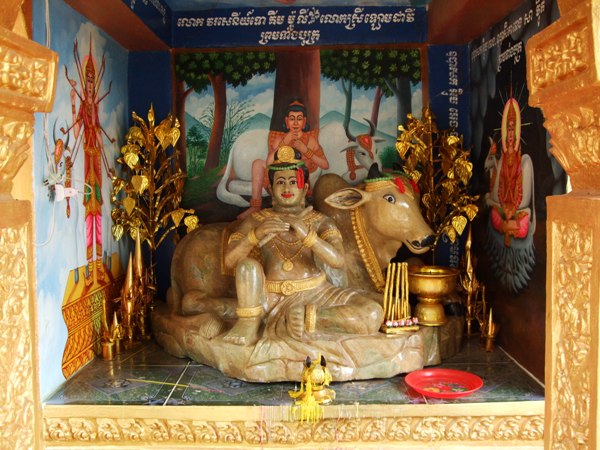
Preah Ko, which means 'the sacred bull' (Shiva's vehicle Nandi), was built by Indravarman I in 879. It is part of the Roluos group of monuments about 13 kilometers east of Siem Riep. The temple is distinguished from others in the area by the unusual arrangement of its six central towers, which stand in two rows facing east.

The three towers on the east side are staggered so that the central tower is slightly further to the west. This tower is dedicated to Shiva, the Hindu god closely associated with the rule of Jayavarman II, the founder of the Khmer Empire. The tower to the north was dedicated to the founder of Preah Ko, and the tower to the south was dedicated to the King's father. Each of these shrines once contained a statue, but they were removed at some time in the past.

Phnom Preah Theat

    Phnom Preah Theat is located in Thmey Village and Commune, Stung Treng District, about 2 kilometes (5mn) from Provincial Town. It is a Nature Wildlife and Preserves.
The Phnom Preah Theat, Stung Treng is one of the natural sanctuaries of Cambodia and happens to be one of the chief tourist attractions in Stung Treng. The Phnom Preah Theat, Stung Treng is situated in the quaint realms of the hamlet better known as Thmey. Tourists flock to the Phnom Preah Theat, Stung Treng to get a glimpse of the dense forests of the reserve as well as its unique and rare wildlife.

In fact, some of the grounds of the Phnom Preah Theat in Stung Treng in Cambodia are so thickly filled with vegetation that it is impossible for the sun's rays to penetrate them. There are some pathways that run across the entire length of the Phnom Preah Theat in Stung Treng. These pathways have been constructed so that tourists can walk through them comfortably as the terrains of the Phnom Preah Theat, Stung Treng are quite 'jungly'. However, tourists are not permitted to walk by themselves. The professional guides of the Phnom Preah Theat, Stung Treng escort them through the jungles. This they do to prevent the tourists from encountering wild beasts or getting entangled with some branch of a tree.

So don't start at the slightest rustle of a leaf under your feet because you can be rest assured that your guide won't take you anywhere near a zone that snakes haunt. The conservationists and zoologists of Cambodia and the globe take active measures in the form of breeding programs and feeding programs to prevent the beasts of the Phnom Preah Theat, Stung Treng from reaching the brinks of extinction. The environmentalists and botanists, on the other hand, always look for opportunities so that they can carry out their afforestation measures in the Phnom Preah Theat, Stung Treng. Some of the species of wildlife that the Phnom Preah Theat, Stung Treng is home to are extremely rare and have no chance of survival on this planet unless they avail of the growth and development measures practiced in the Phnom Preah Theat, Stung Treng. For the Phnom Preah Theat, Stung Treng is full of ecosystems and ecological niches that make its environment perfectly compatible for animals to exist.

Nearly six years after my previous visit, just off National Road 2 on the way from Phnom Penh to Tonle Bati, I called into Wat Preah Theat. There's a new vihara under construction and if you didn't know it was there, you'd miss the remains of Prasat Preah Theat, as its tucked away at the back of the pagoda compound. The monks were meditating so no-one was around to pump for details, which was a similar story six years ago, so I'm still no further forward in understanding the history behind this temple. Can anyone shine a light on Prasat Preah Theat, located in the Bati district? There's a couple of prasats that go under the same name, so make sure its the Bati one.

Mekong River Trip to Laos

    The Mekong River between Stung Treng and the Laos border is very light on population and heavy on beautiful scenery. Boulder outcroppings, numerous sets of rapids, swirling pothole currents, wide sweeping stretches of river and forested landscape along the banks all await the boat traveler. It makes for a great trip, either for the traveler that wants to continue on to Laos or for those wanting to enjoy a wild stretch of the Mekong in Cambodia.

The trip is difficult to downright impossible to make on this shallow stretch of the Mekong during the dry season, with cont less sunken islands and a virtual forest of trees growing right in the middle of the river. The trip becomes an obstacle course for the boat drivers this time of the year, as they carefully try to choose the best way to guide their craft through the maze that nature has created without losing a propeller to the river. The best time of the year to take this trip is from May to November when sufficient upstream rains have raised the river to a level that allows the boats to pass through carefully.

There is not a whole lot to do once you get to the border area, but travelers can leave their passport with Cambodian immigration (at the small checkpoint on the west bank of the river) and cross to the Laos side to eat at a riverside restaurant and look at the tiny market in the Laos village of Geedahn. Cambodian immigration officers may ask you see them, but it is not a fee set by the central government so you don?t have to pay it. There is also a guesthouse to stay at near this village (on the Laos side of the river, but a couple of hundred meters south along the riverbank where it is still Cambodia).

Which was built here for border traders that lose the day light hours and need a place to spend the night. It's a nice enough place, but overpriced, with a room that includes two big beds and a fan going for US$ 8 a night. Electricity is running between dusk and midnight. To take the trip, head down to the riverbank area (near the small bullet boats just east of the pier) in Stung Treng town before 8:30 am and talk to one of the operators of the small freight boats. The fare is 15,000 riel (one way) and the trip to the border area takes about 5 ? hours, but is cut down to just over three hours on the trip back south as the swift current on this stretch of the Mekong pushes the boats right along.

If you want a faster journey, approach one of the small fiberglass boat operators, the ones that have the 40-hp outboard motors-they want US$ 20-$25 (one-way) to make the trip- but if you are looking for a quick trip or fast fun, the trip time going upriver is cut down to only 1 ? hours. The slow boats are fast enough coming back downstream so you could save money by grabbing one of those on the return trip. For those wanting to cross into Laos using this route you will need a Laos's visa in your possession and you also need to stop at the main police station in Stung Treng town (see map) to get a letter of permission to cross the border at this point. This is shown to Cambodian immigration will not let you stamp out of the country without this letter.     

Koh Ksach Resort

    Koh Ksach Resort is located along the river of Se Kong in 5 kilometer distance from the provincial town. The site features a beautiful sandy beach, 2 kilometers long and one-half kilometer wide, where visitor can swim or relax. A natural site, it can be visited only during the dry season and especially popular during Khmer New Year.

Koh Ksach Resort, Stung Treng provides good accommodation to the travelers who come here from all parts of the world. This is a fine resort and is known for its hospitality as well as for its location. It has a very picturesque location. This makes Koh Ksach Resort, Stung Treng one of those attractions in Stung Treng that promises to provide some charming scenery.

If you want to reach the Koh Ksach Resort, Stung Treng within a short time then you should take a boat ride down the Mekong River. This is one of the well known rivers here. After reaching this resort you will be introduced to its hospitality. It can easily compete with the resorts of international repute.

Travelers lodging in the resort will also get a chance to take a closer look at the river. It feels good to walk down the sandy beach with your partner by your side. Koh Ksach Resort, Stung Treng has a sandy beach in the vicinity. This beach is also a place of entertainment and you can play games like beach volleyball. You can take the pleasure of boating in the river.

If you are unsure about the time of visiting this place of sightseeing in Stung Treng then you can try it out at the time of New Year of Khmer. This is the time when most of the tourists check in to the Koh Ksach Resort, Stung Treng.

Kantuy Ko

   Kantuy Ko, Stung Treng is a place that works as a sanctuary to plants and animal here. If you want to take the pleasure of fresh air and greenery then this is the place to visit. In fact that is the reason why travelers love to come here year after year. In fact it is one of the most visited sightseeing spots in Stung Treng. Kantuy Ko, Stung Treng is quite near to the Samki Village.

That is why you can access Kantuy Ko, Stung Treng from the village. This serves two purposes. One is you will be able to interact with the village people and the other of course is to explore the sanctuary. The collection here is a very good one. You will find all kinds of animals here.

Travelers will be able to reach Kantuy Ko, Stung Treng very easily from the center of the city. The animals that are available here include many endangered species as well. You will find tigers and other mammals. There are various kinds of reptiles here too.

As far as the plants are concerned, you will find a number of varieties of them here. Kantuy Ko, Stung Treng is definitely one of the perfect Tourist Attractions in Stung Treng that provides a combination of knowledge and thrill. The Indochinese Tiger is one of the main attractions here. It is one of the endangered species in the world.

Like other attractions in Stung Treng, this one too promises a few wonderful moments. You can capture those moments in your camera so you can refer to them later

Hang Kho Ba Pagoda

    Hang Kho Ba Pagoda is the cultural and historical site, located at Hang Kho Ba Village, Hang Kho Commune, Steung Treng District in Six-Kilometer distance from the provincial town by the road to the airport, then turning left across the river of Se Kong. The pagoda of Hang Kho Ba is over 300 years. The local people there speak Lao majorly. Steung Treng province has been recognized in two special characteristics:
 - The province riches in sweet tamarind fruit.
- The province riches in Pa Si Yi fish .
- Pava fish.Hang Kho Ba Pagoda, Stung Treng is one of the most beautiful pagodas in this Cambodian town. Pagodas are basically temples that were built to worship Buddha. These pagodas are synonymous to Buddhism. In Cambodia most of the population is Buddhist. This temple is also known for the design that is etched on its walls. Hang Kho Ba Pagoda, Stung Treng is located in the Hang Kho Commune.

While exploring the various Tourist Attractions in Stung Treng travelers cannot miss the Hang Kho Ba Pagoda, Stung Treng. It is, in fact, an important part of the cultural history of the city. This place was built 300 years ago. Despite its age the place is still pretty strong and you will be able to appreciate the beauty of its design.

Apart from the aestheticism that it reflects, the Hang Kho Ba Pagoda, Stung Treng has a very nice location. Travelers find the surroundings really enchanting. You can easily access this spot of sightseeing in Stung Treng from the nearest airport. It is just six kilometers from the airfield. The Mekong River is quite near to the structure making its location even more hypnotizing.  If you come to Hang Kho Ba Pagoda, Stung Treng you will see various Buddhist artifacts. These temples are not only places of worship but also act as museums by providing information to the curious souls.  After sightseeing if you feel tired and hungry then you can have Pava fish in lunch. It is the special menu that can be tasted in this part of the country.

Monday, September 27, 2010

Phnom Prich Sanctury

Phnom Krorvanh
    Phnom Prich Sanctuary, Mondulkiri is one the popular tourist attractions in Mondulkiri. The sanctuary is located amidst the Eastern Plains which is known for the sprawling rain forests and beautiful rivers. Thousands of tourists and nature lovers visit Phnom Prich Sanctuary, Mondulkiri to experience the idyllic scenic landscape.

Phnom Prich Sanctuary in Mondulkiri is a part of the initiative undertake by the Cambodian Government to conserve the diverse flora and fauna in the country. The sanctuary forms part of the 1 million hectare of land in the Eastern Plains. The WWF has also helped the government in the undertaking.

The Phnom Prich Sanctuary is home to some of the endangered species in the country. There are wide varieties of mammals, birds and reptiles. Some of the protected species in the sanctuary are tiger, Asian elephant, wild water buffalo, jungle cat, and deer and so on. Some bird species include sarus, crane and giant ibises. The sanctuary provides a wonderful habitat for these animals.

Various trips are undertaken to the Phnom Prich Sanctuary, Mondulkiri. There are also provisions for camping in the forest. There are single day as well as half day trips available. Travelers can take useful information on the sanctuary from the tourist center and the travel agencies.